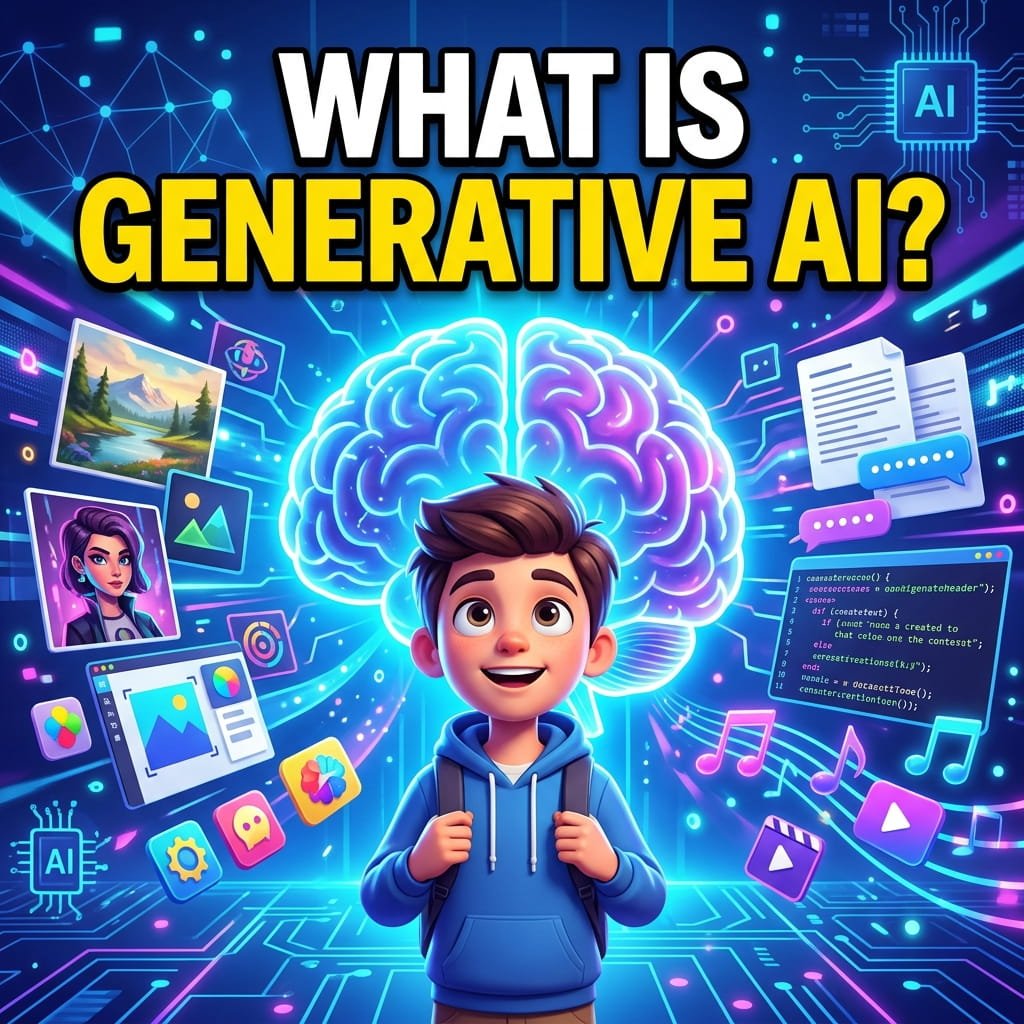
What Is Generative AI? A Complete Beginner’s Guide (2026)
Have you ever wondered how a computer can suddenly write poetry, design stunning home decor layouts, or code an entire website in seconds?If you have been on the internet lately, you have probably heard the buzzwords. Artificial Intelligence. Machine Learning. Deep Fakes. ChatGPT. Midjourney.But out of all these terms, one stands out as the ultimate game-changer for our daily lives: Generative AI.In 2026, Generative AI is no longer just a futuristic concept from a sci-fi movie. It is here, it is easily accessible, and it is actively transforming how we work, create, and communicate.Whether you are a digital creator looking to automate your workflow, a student researching a complex topic, or just a curious internet user, understanding this technology is essential.You might be feeling a little overwhelmed by all the technical jargon. That is completely normal.The world of artificial intelligence moves fast. It can feel like you need a degree in computer science just to understand the morning news.But here is the good news: you do not need to be a tech genius to understand Generative AI.In this complete beginner’s guide, we are going to break down exactly what Generative AI is. We will strip away the confusing terminology and explain it in plain, simple English.Grab a cup of coffee, sit back, and let’s dive into the fascinating world of artificial intelligence.What Exactly Is Generative AI?To understand Generative AI, we first need to understand standard Artificial Intelligence (AI).Traditional AI is built to analyze things. It looks at data, recognizes patterns, and makes decisions based on what it sees.For example, traditional AI is what powers the recommendation algorithm on your favorite streaming service. It looks at what you watched, analyzes the genre, and suggests something similar.It is brilliant, but it is not truly creating anything new. It is just sorting and predicting based on existing information.Generative AI, on the other hand, is a completely different beast.As the name suggests, Generative AI generates. It creates brand-new content from scratch.Generative AI is a type of artificial intelligence that can create new text, images, video, audio, and even computer code based on instructions given by a human.Instead of just analyzing a picture of a living room, Generative AI can design a brand-new, unique living room concept that has never existed before.Instead of just checking your spelling, it can write a 1,000-word essay on the history of the Roman Empire.It takes the building blocks of human knowledge and rearranges them into something entirely original.The Magic of “Prompts”How do you get this AI to create something for you? You use something called a prompt.A prompt is simply a set of instructions you type into the AI interface.Think of it like giving directions to a highly skilled, incredibly fast assistant.If you want a picture, you might type: “Create an image of a modern, minimalist bedroom with large windows and indoor plants.”Within seconds, the AI reads your prompt, understands the concepts of “minimalist,” “bedroom,” and “plants,” and generates a stunning feature image.The better and more detailed your prompt, the better your final result will be.How Does Generative AI Actually Work?Now, you might be asking: “How does a machine know what a minimalist bedroom looks like? How does it know how to write a catchy article?”It is not magic, even though it sometimes feels like it. It all comes down to data and training.1. Massive Data ConsumptionGenerative AI models are trained on unimaginable amounts of data.To teach an AI how to write, scientists feed it millions of books, articles, websites, and conversational logs.To teach an AI how to create images, it is shown billions of pictures paired with text descriptions.The AI studies these vast datasets for months.2. Finding the PatternsAs the AI consumes this data, it doesn’t just memorize it like a hard drive. It looks for patterns.It learns the rules of grammar. It learns that the word “apple” is usually followed by words like “red,” “fruit,” or “tree.”In the visual realm, it learns that “lighting” creates shadows, and that “cats” typically have two pointy ears and a tail.3. Predicting the Next StepWhen you ask a Generative AI text model a question, it is essentially playing an incredibly advanced game of autocomplete.Based on everything it has learned, it predicts which word should logically come next.Then it predicts the next word. And the next. It does this so fast that a whole paragraph appears on your screen in an instant.It is mimicking human understanding by relying on complex mathematical probabilities.The Main Types of Generative AI (With Examples)Generative AI is not just one single tool. It is a broad category that covers several different types of media.Let’s look at the main categories you will encounter in 2026.Text Generation (Large Language Models)This is the most common form of Generative AI. These are systems designed to understand and generate human-like text.They can write essays, summarize long documents, translate languages, and even tell jokes.Popular Tools: ChatGPT, Google Gemini, Claude.Best Uses: Drafting emails, writing blog posts, brainstorming ideas, and answering complex questions.Image Generation (Diffusion Models)Image generators have taken the creative world by storm. You type in a description, and the AI creates a visual masterpiece.These tools are incredibly valuable for content creators, marketers, and web designers.If you are running a Pinterest account focused on interior design, you can generate endless room layouts, color palettes, and decor inspirations without ever picking up a camera.Popular Tools: Midjourney, DALL-E 3, Stable Diffusion.Best Uses: Creating feature images for articles, generating social media graphics, designing logos, and concept art.Video GenerationCreating video traditionally requires expensive equipment, actors, lighting, and editing software.Generative AI is changing that by allowing users to create video clips purely from text.You can ask the AI for a “cinematic shot of a busy street in Tokyo at night,” and it will render a high-quality, moving video clip.This is a game-changer for digital marketers who need short, engaging clips to upload to Instagram or TikTok.Popular Tools: Sora (by OpenAI), Runway, Pika Labs.Best Uses: B-roll footage, short social media reels, animated presentations, and marketing videos.Audio and Voice GenerationHave you ever heard a digital voice that sounds exactly like a real human, complete with breaths and emotional inflections? That is audio AI.These models can clone existing voices or generate completely new, royalty-free music tracks.Popular Tools: ElevenLabs, Suno AI.Best Uses: Voiceovers for videos, podcast generation, custom background music, and audiobook narration.Generative AI vs. Traditional AI: A Quick ComparisonTo make things even clearer, let’s look at a side-by-side comparison of Generative AI and Traditional AI.FeatureTraditional AIGenerative AIPrimary FunctionAnalyzes and predicts.Creates and innovates.OutputNumbers, classifications, yes/no answers.Text, images, audio, video, code.ExampleSpam filters, product recommendations.ChatGPT, Midjourney, AI music generators.Input RequiredStructured data.Natural language prompts.Learning StyleRecognizes existing patterns.Learns patterns to build something new.This clear distinction shows why Generative AI has caused such a massive shift in the tech industry. It moved AI from the background (sorting data) to the foreground (creating content).Why Generative AI is a Game Changer for Everyday PeopleYou might be thinking, “This sounds cool for tech companies, but how does it help me?”The beauty of Generative AI in 2026 is its accessibility. You do not need to know how to code to use it.Here are a few ways everyday people are using this technology right now.1. Supercharging ProductivityGenerative AI is the ultimate personal assistant. It can read a 50-page PDF and give you a bullet-point summary in five seconds.It can organize your messy notes into a structured to-do list. It can even help you plan a week-long travel itinerary, complete with hotel recommendations and daily activities.By automating repetitive tasks, it frees up your time to focus on what actually matters.2. Breaking Creative BlocksStaring at a blank page is the worst feeling for any creator. Whether you are writing an article or designing a graphic, getting started is the hardest part.Generative AI acts as a fantastic brainstorming partner.You can ask it to give you ten catchy titles for a new blog post. You can ask it for five different angles on a specific topic.Even if you don’t use the exact output the AI provides, it sparks your imagination and gets the creative juices flowing.3. Leveling the Playing Field for CreatorsIn the past, running a successful digital media presence required a whole team. You needed a graphic designer, a copywriter, and a video editor.Today, a single person can do it all.You can use AI to write the script, generate the voiceover, create the background images, and assemble the video.This empowers independent creators to produce high-quality, professional-level content that rivals massive media agencies.The Challenges and Limitations of Generative AIAs amazing as this technology is, it is not perfect. It is important to approach Generative AI with a healthy dose of critical thinking.The models are incredibly smart, but they can still make frustrating, and sometimes hilarious, mistakes.The Problem of “Hallucinations”One of the biggest issues with AI text models is something scientists call “hallucinations.”Because the AI is predicting the next word based on probability, it doesn’t actually know if what it is saying is a fact. It just knows it sounds confident.Sometimes, the AI will completely invent a fact, a historical event, or a scientific paper, and present it as the absolute truth.This is why you must always fact-check AI-generated content, especially if you are using it for research or professional work.Visual Glitches and Text in ImagesIf you have used image generators, you know they still struggle with certain details.Human hands are notoriously difficult for AI to generate accurately, often resulting in six or seven fingers.Furthermore, AI image generators struggle to create legible text. If you ask for a billboard with a specific phrase, the AI will often generate a jumbled, alien-looking language.When you need an image for a feature article, it is often best to generate the artwork cleanly and add your own text overlays later using design software.Lack of True UnderstandingIt is crucial to remember that AI does not have feelings, beliefs, or true comprehension.It does not understand the emotional weight of a sad story, nor does it truly understand the physics of a building it just designed.It is a masterful mimic, but it lacks human empathy and lived experience.Ethical Concerns in 2026With great power comes great responsibility. The rapid rise of Generative AI has sparked massive ethical debates worldwide.As the technology becomes more integrated into our lives, society is being forced to answer some difficult questions.Copyright and Intellectual PropertyRemember how we mentioned that AI is trained on millions of images and texts? Much of that data was created by human artists and writers.Many creators argue that their work was scraped from the internet without their permission or compensation.When an AI generates a new image that looks remarkably similar to a specific artist’s unique style, who owns the copyright? Is it the person who wrote the prompt, the AI company, or the original artist?These legal battles are currently shaping the future of digital ownership.The Rise of DeepfakesGenerative AI can perfectly mimic a person’s face and voice. While this is great for movie dubbing, it is terrifying for misinformation.”Deepfakes” are AI-generated videos or audio clips that make it look like a real person said or did something they never actually did.This poses a massive threat to political elections, personal reputations, and financial security.Tech companies are working hard to implement watermarks and detection tools, but it is a constant game of cat and mouse.Job DisplacementWill AI steal our jobs? It is the question everyone is asking.The truth is, Generative AI will automate certain tasks. Jobs that rely heavily on basic data entry, simple copywriting, and routine customer service are already changing.However, history shows us that new technology also creates new jobs.We are already seeing the rise of “Prompt Engineers”—people who are highly skilled at communicating with AI to get the best results.The consensus in 2026 is this: AI might not replace you, but a person who knows how to use AI very well might.How to Get Started with Generative AI TodayIf you have made it this far, you are probably eager to try this technology out for yourself.Getting started is easier than you might think. You do not need expensive hardware or special software installations.Most of the best tools are available right in your web browser.Step 1: Choose Your PlatformIf you want to start with text, create a free account on platforms like ChatGPT, Google Gemini, or Claude.If you want to try image generation, look into Midjourney or free alternatives like Microsoft Designer (powered by DALL-E).Step 2: Start SimpleDo not try to write a masterpiece on your first try. Start with simple prompts.Ask the AI to explain a complex topic to you like you are a five-year-old. Ask it to write a recipe based on the ingredients you have in your fridge.Get a feel for how the AI responds to different instructions.Step 3: Refine Your Prompting SkillsThe secret to mastering AI is learning how to iterate.If the AI gives you a response that is too long, tell it: “Make this shorter.”If the tone is too boring, tell it: “Rewrite this in a more enthusiastic and humorous tone.”Treat the AI like a collaborative partner. Keep adjusting your instructions until you get the exact result you want.The Future of Generative AIWhere do we go from here? The pace of innovation in AI is staggering, and the models are only getting faster, cheaper, and smarter.Hyper-PersonalizationIn the near future, Generative AI will become deeply personalized to your specific tastes.Imagine reading an article where the AI automatically adjusts the vocabulary and examples to perfectly match your reading level and personal interests.Imagine a virtual assistant that knows exactly how you like your emails formatted and drafts them in your exact tone of voice without you having to ask.Integration into EverythingRight now, we largely visit specific websites or apps to use AI. Soon, that will change.Generative AI will be seamlessly integrated into the tools we use every single day.It will be built directly into our word processors, our web browsers, our smart home devices, and our smartphones. It will become as invisible and essential as the internet connection itself.The Shift from Creation to CurationAs generating content becomes effortless, the value will shift from creation to curation.When anyone can generate a beautiful image or a well-written article in five seconds, human taste becomes the most valuable asset.The most successful digital creators won’t be the ones who can produce the most content. They will be the ones who have the best eye for what is truly engaging, unique, and culturally relevant.Final ThoughtsGenerative AI is not a passing trend. It is a fundamental shift in how humanity interacts with technology.It is completely normal to feel a mix of excitement and apprehension about these changes. The world is evolving rapidly.But by taking the time to understand the basics—how it works, what it can do, and where its limitations lie—you are already ahead of the curve.You don’t need to be an expert to benefit from Generative AI. You just need to be curious.Start experimenting. Use it to solve a small problem in your workflow, or use it just to have fun and explore your creativity.