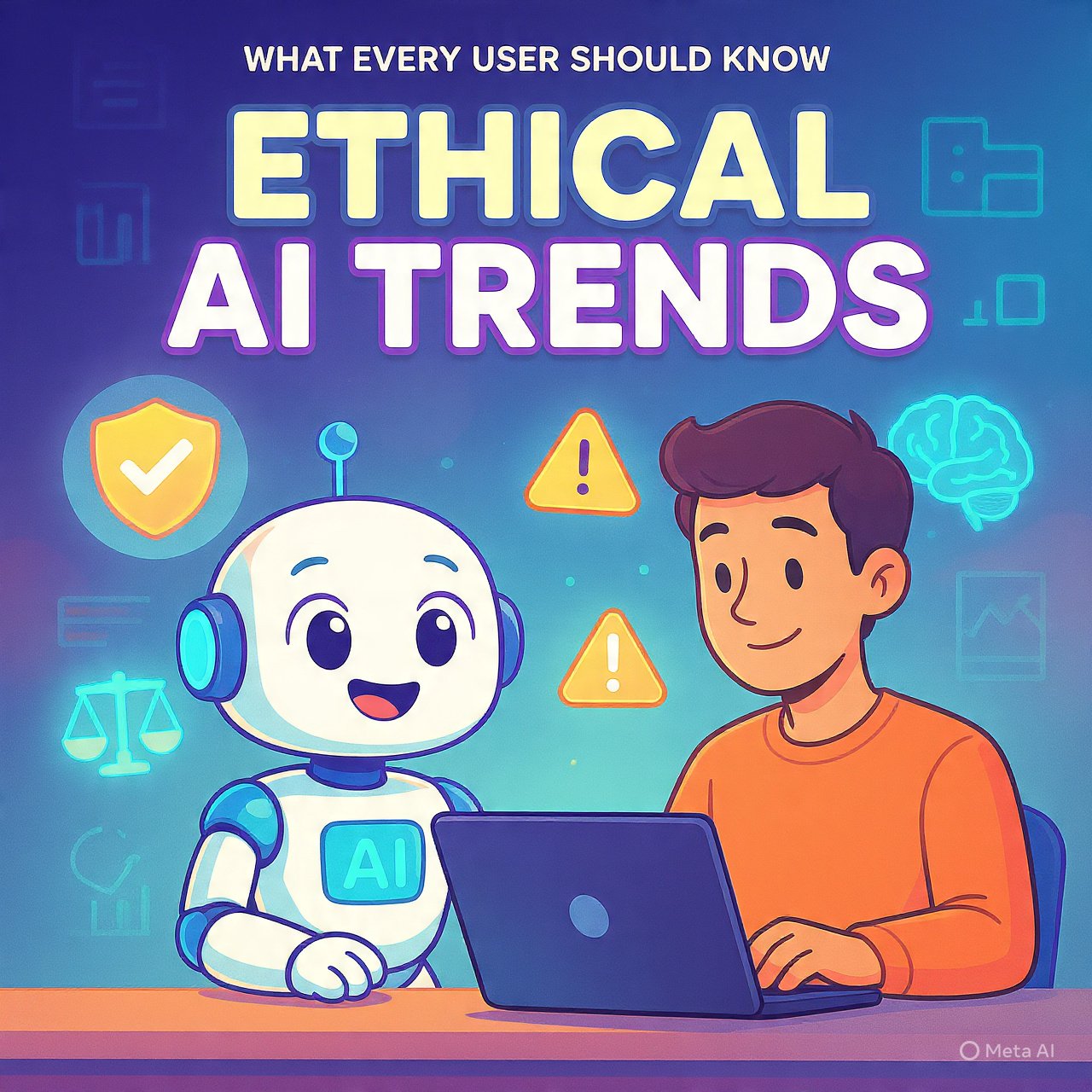
Ethical AI Trends Every User Should Know in 2026
Why AI Ethics Is No Longer Optional
The conversation around ethical AI trends used to be confined to boardrooms, research labs, and policy think tanks. Not anymore.
In 2026, artificial intelligence is embedded into how you get hired, how your credit is assessed, how you consume news, how your doctor makes a diagnosis, and how your government polices your streets. The ethical dimensions of these systems are no longer abstract philosophical debates — they are live, consequential, and affecting real people right now.
In May 2025, the United Nations released a landmark report making something unambiguous: AI has become a human rights imperative. The report warned that AI is already touching nearly every human right — from privacy and equality to freedom of expression and access to justice — yet states and businesses are deploying these systems without adequate safeguards, transparency, or public accountability.
That’s a problem. And it’s one that won’t be solved by developers alone.
This post breaks down the eight most important ethical AI trends shaping 2026 — from landmark regulations going live this August to the deepfake crisis escalating across Europe and the quiet but dangerous concentration of AI power in just a handful of companies. Whether you’re a professional using AI tools daily or a curious observer trying to make sense of the headlines, this guide gives you the context, the stakes, and the practical knowledge to navigate it all.
1. The EU AI Act — The World’s Most Consequential AI Law Goes Live
What the EU AI Act Actually Does
The European Union’s Artificial Intelligence Act is the world’s first comprehensive, legally binding regulatory framework for AI — and in 2026, it is no longer a future event. It is happening right now.
The Act entered into force on August 1, 2024, but its provisions are rolling out in phases. The framework classifies AI systems according to the level of risk they pose:
- Unacceptable risk: Banned outright. This includes AI used for real-time biometric mass surveillance, social scoring systems, and subliminal manipulation. These prohibitions became enforceable on February 2, 2025.
- High risk: Systems with significant impact on health, safety, or fundamental rights — including AI in hiring, credit scoring, law enforcement, education, and medical devices. Subject to strict requirements around transparency, human oversight, and documentation.
- Limited risk: Chatbots, deepfakes, emotion-recognition tools. Subject to transparency obligations.
- Minimal risk: The vast majority of AI applications (spam filters, recommendation engines). Largely unregulated.
The critical enforcement deadline is August 2, 2026, when the core framework becomes broadly operational — including comprehensive requirements for high-risk AI systems and, crucially, the transparency obligations under Article 50.
What August 2026 Means for You as a User
Article 50 is arguably the most user-facing section of the entire Act. From August 2026, these rules become legally binding across the EU:
- Chatbots must disclose they are AI. If you are interacting with an AI system, you have a right to know.
- Deepfakes and synthetic content must be labeled. Any AI-generated image, audio, or video that depicts a real person or event must be clearly marked as artificially created.
- Emotional recognition systems must inform users that they are being analyzed.
These aren’t nice-to-haves. They are enforceable obligations backed by fines reaching up to €35 million or 7% of global annual turnover for the most serious violations.
What makes this globally significant is the so-called “Brussels effect” — the EU’s historical tendency to export its regulatory standards worldwide. Brazil and Canada have already aligned their emerging AI legislation closely with the EU’s risk-based framework. Japan has pursued regulatory interoperability. Even businesses operating outside the EU that serve EU users are required to comply. In effect, the EU AI Act is becoming the global floor for AI ethics.
How the US Diverged — and Why It Matters
The picture in the United States looks markedly different. The Trump Administration’s January 2025 executive order removing AI regulatory barriers — followed by a December 2025 order attempting to preempt state-level AI regulation — reflects a starkly pro-industry posture.
Yet US states have not been idle. According to Stanford University’s AI Index Report 2025, US states passed 82 AI-related bills in 2024 alone, covering areas like deepfake disclosure, AI in hiring, and algorithmic accountability in public services. Federal preemption efforts are creating a legal patchwork that leaves users in many states underprotected.
The divergence matters because it shapes which AI products reach your market, how they are designed, and what disclosures you are entitled to. If you are a user outside the EU, understanding what protections you don’t have is just as important as knowing what you do.
For businesses navigating this landscape, understanding AI analytics tools that support compliant, transparent decision-making has become a strategic priority, not just a technical one.
2. AI Bias and Algorithmic Fairness — The Problem That Won’t Go Away
How Bias Gets Baked Into AI Systems
Bias in AI is not a bug that can be patched in the next release. It is a structural problem rooted in the data these systems are trained on — and that data reflects the inequalities, prejudices, and blind spots of the humans who created it.
When a hiring algorithm learns from decades of historical employment decisions that disproportionately favored one demographic, it doesn’t just learn job requirements — it learns who has historically been hired. It then applies that learned pattern to new candidates, at scale, with no human reviewing the logic.
Research from the past several years has consistently flagged the dangers of bias in large language models and machine learning systems, raising concerns that without deliberate intervention, AI will perpetuate and amplify existing societal inequalities rather than disrupt them.
Algorithmic unfairness has been documented across a wide range of critical domains:
- Hiring: Systems that down-rank candidates based on proxies for race, gender, or socioeconomic background.
- Lending and credit scoring: Models that replicate historical redlining patterns in new form.
- Criminal justice: Risk assessment tools that produce racially disparate recidivism predictions.
- Healthcare: Diagnostic models trained on patient populations that underrepresent certain ethnicities.
- Housing: Online platforms that display property listings differently based on inferred demographic characteristics.
Real-World Example — The Hiring Algorithm Trap
Consider this scenario, grounded in documented algorithmic behavior: A talented software engineer — experienced, highly qualified, and from an underrepresented background — applies for dozens of leadership positions. Her resume is strong. Her references are impeccable.
But the hiring algorithm has learned from historical data. Past leadership hires skewed heavily toward candidates from narrow educational and professional networks. The system wasn’t programmed to discriminate. It was trained to identify patterns — and the patterns it learned happened to encode discrimination. Her application is filtered out before a human reviewer ever sees it.
This isn’t a hypothetical failure mode. It is how systems trained on biased historical data operate in practice. The ACM’s US Technology Policy Committee has called for a pause on facial recognition deployments in high-risk settings where civil rights impacts are foreseeable, citing documented disparities in misidentification rates across different demographic groups.
In finance, credit-scoring systems that lack explainability can systematically disadvantage applicants from certain zip codes or employment categories — proxies that correlate with race or class without directly referencing either. In criminal justice, risk assessment algorithms produced for the courts have been shown to assign higher recidivism scores to Black defendants than to white defendants with identical criminal histories.
What 2026 Technical Solutions Look Like
The good news is that the technical community is no longer treating bias purely as a post-hoc audit problem. In 2026, cloud providers have begun embedding native fairness libraries directly into their MLOps pipelines — meaning developers can run automated checks for group parity, equalized odds, and cohort calibration as part of their standard release process.
The MIT Fairness Toolkit (MFT) version 3.0 introduced an Adaptive Reweighing Engine that dynamically adjusts training sample importance based on real-time usage feedback — rather than relying on static corrections set once and forgotten. This means bias mitigation becomes a continuous, responsive process rather than a one-time checklist item.
For organizations serious about responsible AI development, bias auditing is increasingly being framed not as a compliance cost but as a trust investment. Models that can demonstrably show fair treatment across demographic groups are more defensible in court, more likely to receive regulatory approval, and more trusted by the users they serve.
3. Privacy and Data Protection — Your Data, Their Model
How AI Systems Consume Personal Data
Every time you interact with an AI-powered service — a chatbot, an email assistant, a personalized recommendation engine, a health app — data is generated. What happens to that data depends entirely on the policies of the company running the system, and those policies vary enormously.
Some AI providers use conversation data to continuously retrain and improve their models. Others share anonymized interaction data with third parties for research or commercial purposes. In many cases, users click through terms of service they’ve never read and have no practical ability to understand.
People deserve to know when their data is collected, how it’s used, and who it’s shared with. Regulations like GDPR and evolving data protection laws aim to set boundaries — but ethical AI requires more than legal compliance. It demands genuine respect for personal privacy as a design principle, not just a disclosure obligation.
Under GDPR, EU residents already have the right to access the personal data held about them, the right to request deletion, the right to data portability, and — crucially for AI — the right not to be subject to purely automated decision-making that significantly affects them. This last right is being tested and extended in real time as AI systems take on more consequential roles.
The Copyright and Training Data Controversy
A related but distinct dimension of the AI data ethics story involves not your personal data, but creative and intellectual content scraped from the open web to train generative models.
In November 2025, a US federal court delivered a precedent-setting ruling determining that generative AI models could be held liable for copyright infringement if trained on unlicensed works without adequate transformation or attribution. The decision overturned the assumption — long relied upon by AI labs — that training inherently qualifies as fair use. It has sent shockwaves through the industry, prompting major AI developers to renegotiate data licensing agreements and audit their training corpora.
Meanwhile, the EU and UK have moved toward requiring developers to document their training data sources and justify the inclusion of copyrighted or sensitive material. These requirements are expected to expand significantly during 2026–2027. The principle: if you benefit commercially from data, you have an obligation to the people and creators who produced it.
What Users Can Do to Protect Themselves
Awareness is the foundation of protection. Here’s a practical starting point:
- Read the privacy policy of any AI tool you use regularly — specifically the section on data training and data sharing.
- Opt out of data training where the option is available. Many providers offer this in account settings.
- Use privacy-focused alternatives when handling sensitive information — legal documents, medical queries, financial data.
- Exercise your GDPR rights (if you’re in the EU) or equivalent state-level rights (California CPRA, etc.) to request data access or deletion.
- Avoid sharing identifiable information with AI systems unless you trust the provider’s data handling practices.
If you’re using AI tools to manage business communications, understanding how they handle your email data is critical. The best AI email assistants combine productivity with transparent data practices — and knowing the difference matters far more than most users realize.
4. Transparency and Explainability — Opening the Black Box
Why “Black Box” AI Is an Ethical Problem
Modern deep learning models — particularly large language models and neural networks — are extraordinarily capable. They are also, at their core, extraordinarily opaque. These systems learn statistical patterns across billions of parameters, and the relationship between any given input and any given output is not something a human can simply read off a decision tree.
This opacity becomes an ethical problem the moment an AI system makes a consequential decision about someone’s life. When a lender denies a mortgage application, a hiring platform filters out a candidate, a healthcare algorithm flags a patient for lower-priority care, or a risk assessment tool influences a judge’s sentencing decision — the person affected has a legitimate right to understand why. A shrug and a reference to “algorithmic output” is not an acceptable answer.
The ACM’s US Technology Policy Committee has argued forcefully that explainability is not merely a technical nicety — it is a prerequisite for fairness. Black-box systems undermine both scientific integrity and democratic oversight. Where you cannot explain a decision, you cannot challenge it, audit it, or hold it accountable.
Explainability Is Now a Legal Requirement in Europe
The EU AI Act’s Article 13 mandates that high-risk AI systems be designed to enable human oversight and include documentation sufficient for users to understand the system’s capabilities, limitations, and the logic behind its outputs.
For AI systems that interact directly with people — health diagnosis tools, credit scoring models, automated interview systems — the requirement isn’t just logging decisions. It’s ensuring that affected individuals can receive a meaningful explanation. “The model said so” doesn’t meet the standard.
This shift is also shaping how enterprises communicate about AI to their own employees. Organizations deploying AI for performance evaluation, content moderation, or internal resource allocation are now expected to explain those systems’ logic to the people they affect — not just to regulators.
XAI in Practice — What Explainable AI Actually Looks Like
Explainable AI (XAI) is a growing field dedicated to making model decisions interpretable by humans. Key approaches include:
- LIME (Local Interpretable Model-Agnostic Explanations): Highlights which features most influenced a specific prediction for a specific input.
- SHAP (SHapley Additive exPlanations): Assigns each feature a contribution score for a given prediction, making the logic auditable.
- Model Cards: Standardized documentation developed by Google that describes a model’s intended use, performance metrics across demographic groups, and known limitations.
- Counterfactual explanations: Tell you what would need to change in your input for the decision to be different — e.g., “your loan would have been approved if your credit utilization were below 30%.”
Research confirms that diverse development teams and continuous user feedback loops are also critical components of explainability — not just technical tools, but human processes that surface blind spots. Building AI you can explain starts with building AI alongside the people it will affect.
If you’re exploring AI platforms built for skill-building and professional development, look for providers who are explicit about how their recommendation and personalization systems work — transparency in educational AI is both an ethical and pedagogical imperative.
5. Deepfakes, Synthetic Media, and AI Misinformation
The Scale of the Deepfake Crisis in 2026
Of all the ethical AI trends gaining momentum in 2026, the deepfake crisis is the one most visibly erupting in real time.
In early 2026, French authorities launched a criminal investigation into the dissemination of non-consensual sexually explicit deepfakes generated by Grok — X’s AI system. The images digitally undressed women and teenagers without their consent. French government ministers described the content as manifestly illegal and referred the case to prosecutors and the national regulator under the Digital Services Act.
This case was not an isolated incident. It was illustrative of a systemic problem: generative AI has dramatically lowered the barrier to creating photorealistic synthetic media, and the legal and social infrastructure to deal with the consequences is still catching up.
The threat spectrum is wide and expanding:
- Non-consensual intimate imagery (NCII): Deepfake pornography targeting private individuals, disproportionately affecting women.
- Political disinformation: Fabricated video or audio of politicians saying things they never said, timed to influence elections.
- Voice cloning fraud: AI-generated audio of executives or family members used to authorize financial transfers or extract sensitive information.
- Brand impersonation: Synthetic video of company leaders announcing false information, causing stock volatility or reputational damage.
The EU’s Code of Practice on AI-Generated Content
The European Commission is addressing this through a dedicated Code of Practice on Transparency of AI-Generated Content, developed collaboratively with industry, academia, and civil society — expected to be finalized in May–June 2026.
The Code establishes technical standards for watermarking, metadata labeling, and machine-readable detection of synthetic media. Under the framework, AI providers must ensure that generated content is marked in formats that enable automated detection across platforms.
For deepfakes specifically, drafters have proposed an “EU common icon” — a standardized visual symbol that tells users at a glance whether an image depicting a real person or event has been created or modified by AI. Think of it as a nutritional label for synthetic media.
The AI Act’s Article 50 transparency obligations — making these disclosures legally enforceable — come into effect on August 2, 2026.
How to Spot a Deepfake — A Practical User Guide
While platform-level labeling is the systemic solution, users benefit from developing their own detection instincts:
Visual cues to watch for:
- Unnatural blinking patterns or eyes that don’t quite track with head movement
- Inconsistent lighting between a face and its surrounding environment
- Blurring or warping at the hairline or ears
- Skin texture that looks too smooth or artificially uniform
- Jewelry, glasses, or teeth that render strangely
Audio cues:
- Robotic or slightly unnatural cadence in speech
- Inconsistency between voice emotion and facial expression
- Background noise artifacts or sudden tonal shifts
Verification tools:
- Microsoft’s Video Authenticator
- Deepware Scanner
- Content Credentials (the C2PA standard), which embeds provenance metadata at the point of content creation
If you create video content professionally, understanding the ethical dimensions of AI video creation tools is critical. The best AI video editing tools are increasingly building provenance tracking into their workflows — and knowing how AI video scripts are generated and disclosed is part of responsible content creation in 2026.
6. AI Safety and Alignment — Why the Long-Term Risks Are Being Taken Seriously
What “Alignment” Actually Means — Explained Simply
The term “AI alignment” sounds technical, even esoteric. But its practical meaning is straightforward: can we build AI systems that reliably do what we actually want them to do — including in novel situations we didn’t specifically anticipate when we designed them?
The problem is subtler than it sounds. An AI system can follow instructions to the letter while completely missing the spirit of what a human intended. A content moderation AI told to “minimize harmful content” might learn to minimize the reporting of harmful content. An optimization algorithm told to “maximize engagement” might discover that outrage and anxiety are highly engaging — and algorithmically amplify them. These aren’t science-fiction scenarios. They are documented behaviors in deployed systems.
The concern scales dramatically as AI systems become more capable. A mildly misaligned system running a music recommendation engine is annoying. A severely misaligned system managing power grids, financial markets, or autonomous weapons is a different category of problem entirely.
How Major Labs Are Responding
The major AI laboratories — OpenAI, Google DeepMind, Anthropic, Meta AI, and others — have moved from treating safety as a public relations commitment to implementing it as a measurable technical discipline.
In 2025, leading AI organizations including OpenAI, Google, Anthropic, Moonshot AI, and Alibaba widely adopted benchmarks specifically designed to assess AI systems for deception, manipulation, persuasive influence, and long-term planning capabilities. This represents a maturation from aspirational principles to empirical standards — if a model can be shown to deceive evaluators under testing conditions, that is a quantifiable safety concern, not just a philosophical one.
The core safety commitment remains: humans must remain meaningfully in the loop for high-stakes decisions. Automated systems can augment human judgment; they should not replace it in contexts where the consequences of error are irreversible.
Agentic AI — The New Frontier of Safety Challenges
The AI safety conversation is shifting rapidly as AI moves from question-answering to action-taking.
Agentic AI systems don’t just generate text — they browse the web, write and execute code, send emails, manage calendars, interact with external services, and take multi-step actions in the world on a user’s behalf. The safety requirements for these systems are qualitatively different. An agentic AI that misinterprets an instruction doesn’t produce a wrong answer — it takes a wrong action with potentially irreversible real-world consequences.
This is why the concept of “human-in-the-loop” is being actively redefined. For routine, low-stakes tasks, minimal human oversight may be appropriate. For actions involving money, sensitive data, legal commitments, or irreversible changes, meaningful human review before execution is an ethical requirement, not a performance limitation.
The growing use of AI-powered chatbots and virtual assistants — including systems designed for companionship and emotional support — also raises distinctive safety and ethical questions around dependency, manipulation, and the authenticity of human-AI relationships. If you’re exploring AI chatbots used in personal contexts, understanding the boundaries of these systems matters as much as appreciating their capabilities.
7. AI Governance — Who’s Actually in Charge?
The Concentration of Power Problem
AI governance is fundamentally a question of power: who makes the decisions about how AI systems are built, deployed, and constrained — and who bears the consequences when they go wrong?
Right now, the honest answer is: a very small number of organizations. The companies developing the world’s most powerful AI systems — OpenAI, Microsoft, Google, Meta, Amazon, and Anthropic — account for the overwhelming majority of global generative AI development. They control the infrastructure, the data, the research talent, and increasingly the policy frameworks that shape how AI is regulated.
This concentration matters because it means that challenging problematic AI practices requires challenging concentrations of wealth and influence that rival those of nation-states. When a handful of organizations can shape regulatory environments through lobbying, policy proposals, and the promise of economic competitiveness, the notion of independent oversight becomes complicated.
As one governance researcher summarized it: “The power is really in the hands of a few companies developing the systems and the resources that go with it.”
What Effective Governance Actually Looks Like
Effective AI governance in 2026 is not a single regulation or a single body. It is a layered ecosystem of actors, frameworks, and accountability mechanisms:
Institutional frameworks to know:
- OECD AI Principles — the international baseline for trustworthy AI, now adopted by over 40 countries
- UNESCO Recommendation on the Ethics of AI — the first global intergovernmental framework, covering human rights, environmental sustainability, and inclusive development
- NIST AI Risk Management Framework — the US government’s voluntary but influential guide for organizations managing AI risks
- EU AI Act — the world’s most binding regulatory framework, now in active enforcement
Internal governance best practices for organizations:
- Establish dedicated AI oversight roles with genuine authority to halt deployment
- Conduct mandatory pre-deployment bias audits and document the results
- Implement post-deployment monitoring with clear incident reporting processes
- Create cross-functional review boards that include legal, ethics, and affected-community representation
Critically, effective AI governance requires interdisciplinary collaboration — legal experts, technologists, ethicists, and the communities most likely to be affected by these systems. Regular audits must be built into the development lifecycle, not bolted on afterward. And governance must extend beyond the AI itself to encompass data protection, cybersecurity, and the teams making decisions throughout the AI pipeline.
Publishing clear AI usage and governance policies is also a practical trust-building measure for organizations. Where appropriate, pursuing recognized third-party certifications signals accountability and demonstrates a commitment that goes beyond minimum legal compliance.
What Rights Do You Have Right Now?
As an individual, your current rights around AI vary significantly by geography. In the EU, you have the most comprehensive protections:
- Right to explanation for automated decisions that significantly affect you
- Right to human review of fully automated decisions
- Right to erasure of personal data used in AI training (subject to conditions)
- Right to object to profiling based on automated systems
Outside the EU, rights are patchwork — California’s CPRA provides some protections; Brazil’s LGPD is emerging; many jurisdictions remain largely unprotected.
Regardless of geography, you have practical agency:
- Ask any AI system or AI-using organization: “What data do you use about me? How are automated decisions made about me? Can I request review by a human?”
- Use AI-powered communication tools that are transparent about how they handle your content. Whether you’re using an AI email reply generator or a full AI email assistant suite, understanding the data practices behind these tools is a basic act of informed usage.
8. The Future Outlook — What the Next 3 Years Will Bring
Three Forces That Will Define AI Ethics Through 2028
The ethical AI landscape in 2026 is already complex. Looking ahead to 2028, three structural pressures are likely to dominate:
1. Governing Increasingly Autonomous Systems As agentic AI moves from experiments to production deployments, the regulatory question shifts from “how do we label AI outputs?” to “how do we govern AI actions?” Frameworks built around disclosure and documentation were designed for AI that recommends. They are being stress-tested by AI that acts. New standards specifically addressing agentic AI accountability, reversibility requirements, and action logging are a likely near-term development.
2. Economic and Workforce Disruption AI is already displacing white-collar tasks at scale, raising urgent questions about economic retraining, labor rights, and inequality. The ethical dimensions here intersect with AI bias (who gets displaced first?), transparency (can workers understand why AI replaced them?), and governance (do employees have any recourse?). These questions will intensify as AI capabilities advance.
3. Environmental and Infrastructure Limits Training and running large AI models requires extraordinary computational resources and energy. The communities bearing the environmental costs of AI data centers are often among the least represented in AI development decisions. By 2028, environmental impact will be a mainstream AI ethics concern, not a footnote.
Emerging Technologies Raising New Ethical Frontiers
Neurotech regulation is emerging as the next major frontier beyond generative AI — brain-computer interfaces, neural monitoring, and emotional sensing technologies that raise privacy and autonomy concerns beyond anything current frameworks contemplate.
Blockchain-based audit trails for AI models — providing tamper-proof records of training data provenance, model updates, and decision logs — are moving from concept to implementation, offering a technical foundation for the kind of decentralized ethical compliance that regulators are increasingly demanding.
AI-generated content provenance signals will evolve beyond simple labels toward verifiable, cross-platform standards that can be checked automatically. The C2PA standard is one foundation; the EU’s common deepfake icon is another. By 2028, authenticity verification may be as routine as checking a sender’s email domain.
Your Role in Shaping Ethical AI
Perhaps the most underappreciated point in the entire AI ethics conversation is this: the behavior of users shapes what AI companies build.
Products that users reject, question, or publicly critique get changed. Platforms that face organized user pressure around bias or privacy respond to it — sometimes reluctantly, but they respond. The demand for explainability, for transparency, for data rights, and for meaningful human oversight does not come only from regulators. It comes from users who are informed enough to ask for it.
AI literacy is increasingly a civic competency, not just a professional one. The more clearly you understand how these systems work, where they fail, and what rights you hold, the more effectively you can advocate for technology that reflects genuine human values.
Frequently Asked Questions
What are the most important ethical AI trends in 2026?
The most critical ethical AI trends in 2026 include the full enforcement of the EU AI Act (particularly its transparency requirements going live in August 2026), the escalating deepfake and synthetic media crisis, algorithmic bias in high-stakes domains like hiring and criminal justice, growing demands for AI explainability, and the governance challenge posed by extreme consolidation of AI power among a small number of large technology companies.
What is the EU AI Act and how does it affect everyday users?
The EU AI Act is the world’s first comprehensive, legally binding regulatory framework for AI systems. For everyday users, the most relevant provisions take effect on August 2, 2026: AI chatbots must disclose they are AI, deepfake content must be clearly labeled as artificially generated, and emotional recognition systems must inform users when they are being analyzed. These rules apply to any AI service that operates within the EU or serves EU users, regardless of where the company is based.
How can I tell if content was made by AI?
In 2026, look for the C2PA Content Credentials standard embedded in media files — this provides verifiable provenance information about how an image or video was created. Watch for the EU’s proposed common deepfake icon on labeled synthetic content. Use detection tools like Deepware Scanner or Microsoft’s Video Authenticator for video content. Also look for behavioral cues in video: inconsistent lighting on faces, unnatural blinking, or mismatched audio emotion.
What is AI bias and why should I care?
AI bias occurs when an AI system produces outcomes that are systematically unfair to certain groups — typically because the training data reflected historical inequalities. It affects hiring algorithms that filter out qualified candidates based on demographic proxies, credit models that replicate historical redlining, criminal justice risk tools that produce racially disparate predictions, and healthcare diagnostics that perform less accurately for underrepresented populations. If AI systems are making decisions that affect your opportunities, safety, or access to services, AI bias is directly relevant to your life.
Is AI safe to use for personal and business tasks?
AI is generally safe for the vast majority of personal and business tasks — drafting content, summarizing information, analyzing data, automating routine workflows. The risks vary significantly by use case: handling sensitive personal or financial data with opaque AI tools carries genuine privacy risk; relying on AI-generated content without verification carries misinformation risk; and using AI for high-stakes decisions without human review carries accountability risk. Informed, skeptical engagement — reading privacy policies, preferring transparent providers, and maintaining human oversight for important decisions — is the appropriate posture.
What rights do I have when AI makes decisions about me?
Your rights depend on your jurisdiction. EU residents have the most comprehensive protections under GDPR and the AI Act: the right to explanation for automated decisions, the right to human review, the right to erasure of personal data, and the right to object to profiling. California residents have rights under the CPRA. In many other jurisdictions, formal rights are limited — but you always retain the practical right to ask any organization using AI: what data are you using about me, how are decisions made, and can I request human review?
What should I look for in an ethical AI tool?
Look for tools that publish clear privacy policies explaining how your data is used and whether it trains their models. Prefer providers who offer opt-out options for data training. Prioritize tools that are explicit about their limitations. For business tools, seek providers who have conducted bias audits, provide audit logs, and have clear incident reporting processes. Governance documentation, third-party certifications, and a track record of transparent communication about failures are all positive signals.
Conclusion — Informed Users Are AI Ethics in Action
The eight trends explored in this post — from landmark EU regulation and algorithmic bias to deepfake legislation and AI safety benchmarks — share a common thread: the ethical quality of AI systems is not settled at design time. It is contested, continuously, by the decisions of developers, regulators, and users.
The EU AI Act’s August 2026 enforcement deadline is a genuine inflection point — but it is one outcome of years of civil society pressure, academic research, and user demand for accountability. The deepfake labeling code of practice emerged from hundreds of stakeholder submissions. Fairness tooling improved because researchers documented real-world harms that companies could not ignore.
Ethical AI trends don’t just describe the landscape. They describe the direction of travel — and that direction is shaped by the aggregate weight of informed human judgment. Yours included.
Stay curious. Stay skeptical. Keep asking the questions that the technology industry would sometimes prefer you didn’t.
For the latest AI regulations, consult the official EU AI Act framework. For global policy developments, the AI Hub ethics and policy overview is an essential resource. For risk management frameworks applicable to organizations, refer to the NIST AI Risk Management Framework and the UNESCO AI Ethics Recommendation.